
Limit Poker Vs. No Limit Strategy
Example: Play A Limit Hand With Me. A8o is by no means a great hand and generally a dangerous hand to call raises with in NLHE, but in LHE you can assume the limpers are also calling; meaning, you are getting 9:1 immediate odds to call with this hand, making it an easy peel here in the big blind.
- 2 5 No Limit Strategy
- No Limit Holdem Tournament Strategy
- Limit Poker Vs. No Limit Strategy List
- Texas Hold'em No Limit Strategy
Welcome to Low Limit Holdem!
Welcome to Low Limit Holdem Strategy and Tactics. Our focus is on practical strategy on sitting and winning in very loose low limit holdem poker games. You've come to the right place.
We now have some great articles on playing in Low Limit No Limit Texas Holdem. Visit Articles and Essays section to learn more.
Ready to get started? Check out the topics below and visit our Who This Site is For page and start winning at low limit Holdem!
Read about Table Selection, Position, Reading the Board, Probabilities and other general Texas Holdem topics when playing in loose games.
Here are our famous loose Texas Holdem starting hand suggestions, optimized for poker tables when five or more people see the flop.
Loose Texas Holdem strategy on each betting round: Before the flop, on the flop, the turn and the river.
Browse through our dozens of high quality exclusive articles covering a number of low limit holdem topics as well as guides to help you on your way to no-limit play.
In several short articles we give you a map of the most common hidden traps that many Holdem players fall in so you don't have to.
Many online cardrooms offer new players first-time deposit bonuses. Here we describe a low-risk method to turn your bonus dollars into real spendable dollars.
Small Stakes or Low Limit?
So what is the difference between 'small stakes' and 'low limit' poker? The short answer is that there isn't one...
Lee Jones coined the term Low Limit poker in his successful book Winning Low Limit Holdem and 'Noted Poker Authority' Ed Miller uses 'small stakes' to describe the same game in his book titled Small Stakes Hold 'em: Winning Big with Expert Play. In general 'low limit' usually corresponds to any game with a big blind smaller than $5. At live rooms in brick and mortar poker rooms, the lowest of the low limit games are usually $1/$2.
Other Low Limit Casino Games?
Video Poker
2 5 No Limit Strategy
Some of the best odds and video poker strategy information can be found on the Wizard of Odd's web site. It is possible to have the edge on this game with certain progressive machines and online versions of video poker.
Favourite Casino Games
Playing your favourite online casino games should always be a pleasurable experience and you can use onlinecasinos.co.uk to find the best place to play so you will enjoy every moment.
Thank you for visiting!
Low Limit Holdem Strategy and Tactics Last updated Sunday, September 22, 2019
1. Longhand Limit
2. Shorthand Limit
3. Adv. Shorthand
No-Limit Hold'em:
1. Intro to NL
2. Advanced NL
3. Who Pays Off
4. Stack Sizes
5. Double Hold'em
Omaha:
1. Intro to Omaha
2. Low Limit Omaha
3. Intro to PLO
4. Omaha Hi/Lo
Tournaments:
1. Tourney Overview
2. Single-Table NL
3. Advanced NL STTs
4. Multi-Table NL
5. Multi-Table Limit
6. Tourney Variants
7. Knockout Tourneys
8. Ante Up Tourneys
Money Management:
1. Moving Limits
2. When to Quit
3. Short/Long Run
Other:
1. Intermediate Mistakes
2. Utilizing Promotions
In other languages:
| Room | Bonus | Code | Free Money |
| 100% up to $500 | Use Our Link | $8 | |
| $2000 | tips | ||
| Up to $500 | TIPS500 |
Let's first go over general strategy. There are two things you should quickly figure out when you enter a no-limit game:
1. What types of players are my opponents?
2. How many hands go to a showdown?
Types of opponents
Generally, people speak of four types of players: tight-passive, tight-aggressive, loose-passive, loose-aggressive. The first modifier (tight or loose) characterizes the number of hands the person plays while the second (passive or aggressive) describes the player's betting style. I think that for no-limit hold'em, loose-aggressive should be divided into two parts: maniacs and solid players. Let's go over each of these types of players.
Tight-passive: These people do fine in a fixed-limit game, but they won't win much money in a no-limit game. This is because they do not get full value out of their winning hands. When playing against these players:
1. Bluff at the flop a lot. Put in a raise preflop, and try to take down the pot at the flop.
2. Fold when they represent a hand. If they bet a little, they're probably on a draw or have a weak hand. In this case, you should still stick with your hand if you hold something decent. If they bet a lot, they probably possess a solid hand.
3. Take advantage of your control. Don't go wild with your bluffs, though. You should still fold preflop when you have nothing. If you make a flop bluff, think twice before making another bluff on the turn. Also, you can still win a fair amount of money off of these types of players when you hold a good hand.
 Essentially, you can quickly tame these players into calling stations or folding stations. If one of these players is making a lot of money against you while being a calling or folding station, you are doing something seriously wrong. These players are common, and you will certainly encounter quite a few of them.
Loose-passive: These players have to hope that people continually bluff into them, because they frequently call with the second-best hand. Calling with the second-best hand is a recipe for disaster at no-limit games. You won't often see loose-passives playing no-limit hold'em, because they lose money too quickly playing the game. If you are fortunate enough to have a loose-passive player at your table, just win money off of him by making mid-sized bets when you hold a good hand.
Maniac loose-aggressive: These guys will buy a fair share of pots. However, they will often get themselves trapped, and they will lose their stacks in one or two hands. What separates these players from good loose-aggressives is that they lack discipline. They love the action of no-limit so much that they get themselves trapped too easily. These types of players are rare.
Strong loose-aggressive: These guys seem like they are horrible maniacs, but in reality, they are a very dangerous form of player. They will certainly lose a lot of money in pots, but they also will buy a lot of pots and win huge ones. Many of the best no-limit players in the world use this style, but I would not recommend trying to mimic this style as a beginner. The way these players win is mainly by getting a good read on the opponent, and then making a well-timed bet.
One way I try to beat these guys is to take them down in one big pot. Since they will play a lot of hands, especially shorthanded, they'll often play hands that lend themselves to being the second-best hand. Once I catch them in this situation, I just have to make sure I don't let them go too easily. Another tip is to make sure you are playing in a game where the money is not too meaningful to you. You should not let these players scare you financially when they make a large bet or raise. You need to be able to play back at these guys by re-raising or call them down.
These players only do well when people have large stacks. If you or the loose-aggressive player has a small stack, you are at an advantage because their ability to bluff is limited.
Tight-aggressive
 : This is my style and the strategy that I'll teach. The tight-aggressive's main problems are that he may get bluffed out too easily and that he may be too easy to read.
Showdown Percentage
 This is a critical concept in no-limit hold'em. Since no-limit lends itself to bluffing, one can make a lot of money simply by stealing pots if your opponents are very tight. However, this strategy obviously fails if everyone shows you down at the river!
Generally, before I play in a game, I pay attention to the number of hands going to showdowns. This is really easy to do on the internet because you don't even need to watch the game. You just leave the window open, go eat a snack, go to the bathroom, whatever. Come back twenty minutes later and see what sort of game you are about to dive into. All you have to do is scroll through the chat box and see how many hands went to showdowns and how big the pots tend to get.
All things being equal, more showdowns are better. While it is impossible to bluff if everyone calls you down, you stand to make a lot more money if people call you with tenuous holdings. The best way to make money at no-limit games is to simply sell your hand when you have it. If people call down a lot, you will be able to extract a lot of money from pot-sized or larger bets when you hit a premium holding (such as a flush or set).
Types of Hands to Play
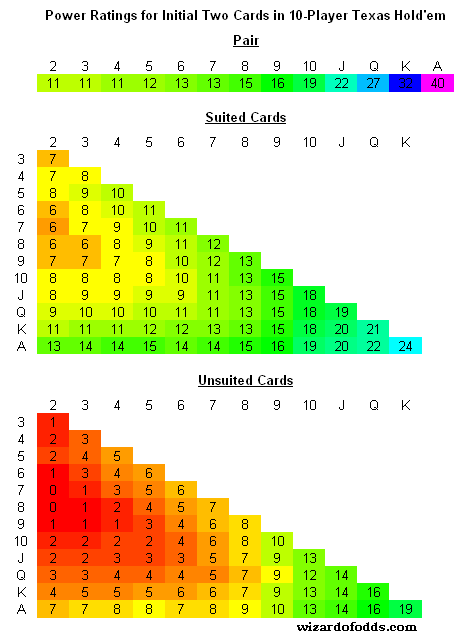
The types of hands you play in no-limit differ than those in fixed-limit. This is because of implied odds. Hands like KQ go down in value because they cannot withstand much pressure. Even if you hit a King with this type of hand, you still may be losing to a set, two pair, AK, or eventually to a draw. Thus, with big cards, you generally want to take down the pot at the flop. The exception to this is if you think you have someone outkicked (like with AK vs. KJ with a K on the board), or if you hit the flop hard (like KK3 when you hold AK). In these cases, you generally want to extract money from your opponent bit by bit.
The types of hands that go up in value or ones that you can bet with confidence: pocket pairs and suited connectors (strong draws in general). Pocket pairs do well because they are sneaky and can often withhold pressure. With pocket pairs, you can bet hard if you have a set or an overpair, which are hands that people generally don't expect. Suited connectors go up in value for several reasons. First, if the flop comes weird, you generally will be paid off.
You'll get paid off a lot more on this flop than you would lose to the AK if the flop were A 7 2.
Furthermore, you can take down pots and disguise your hand with semi-bluffing.
People will probably put you on a Jack if you bet at this flop. They will then either fold or call. You'll either take down the pot at the flop, or you'll be drawing to a hand that people don't expect.
Please realize that your stack size greatly affects the types of hands you should play. Big, unpaired cards like AK or KQ do better with smaller stacks, while suited connectors are more effective with larger stacks. For more information about this, check out Stack Sizes.
How to Bet
Many novice no-limit players simply don't know how much to bet. Here's the concept in a nutshell. You want extract as much money as you can from opponents who have made hands but are losing to you. You want to give people with draws bad odds. At the same time, you don't want to trap yourself.
You want to put in pot-sized bets here. This is because your opponent probably has either a straight draw or a pair of Aces. If he has a straight draw, you don't want him to draw on the cheap. If he has pair of Aces, he probably won't let go of them, so take as much as you can.
Bet into this flop, but don't bet too much. A proper bet would be just enough to make people fold if they don't have an Ace but enough to maybe make an AQ freeze up and 'just' call. A half-pot-sized bet would be advisable in this situation. This way you draw relatively cheaply and can punish your opponents if you hit your flush.
Bluffing
This relates back to the showdown percentage. More showdowns means bluffing is less effective. Less showdowns means bluffing could be more effective. If you are in a game with a lot of showdowns (typical of lower stakes), cut down on bluffing and punish them when you have a strong hand.
Next Article: Advanced No-Limit Hold'em
| Check Raise |
| 10nl 6 max - AQo on the Button |
| 2 pair on the river facing a shove |
| $88 | |
| Create an account and get up to $88 no deposit required, use our link. | |
No Limit Holdem Tournament Strategy
| How To Create A Great Atmosphere For Your Home Poker Game |
May 30 |
| 27 Questions to Ask Yourself During a Poker Hand |
May 20 |
| The Pros Are Jumping on Twitch: Get In On the Ground Floor |
April 30 |
Limit Poker Vs. No Limit Strategy List
Party Poker Launches Casual Cash Games
Ryan Riess wins 2013 WSOP
US Players Able to Receive Full Tilt Money Soon
Texas Hold'em No Limit Strategy
The Top 9 Myths About Online Poker
The 4 Worst Tips Given To Beginner Poker Players (Don't Fall Into These Traps)